

The First 90 Days: A Specialist Guide to Bringing a New Dog Home
Congratulations on your new companion. At Small Dog Adoptions, we view the arrival of a small dog – whether a purebred or mixed breed – not just as an adoption, but as a delicate process of emotional recalibration.
While the “3-3-3 rule” is a widely recognized industry standard, we recognize that small dogs breeds are individuals with high sensory awareness. This guide provides the behavioral framework for a safe, low-stress integration into your lifestyle.
Beyond the 3-3-3 Rule: Milestones Over Deadlines
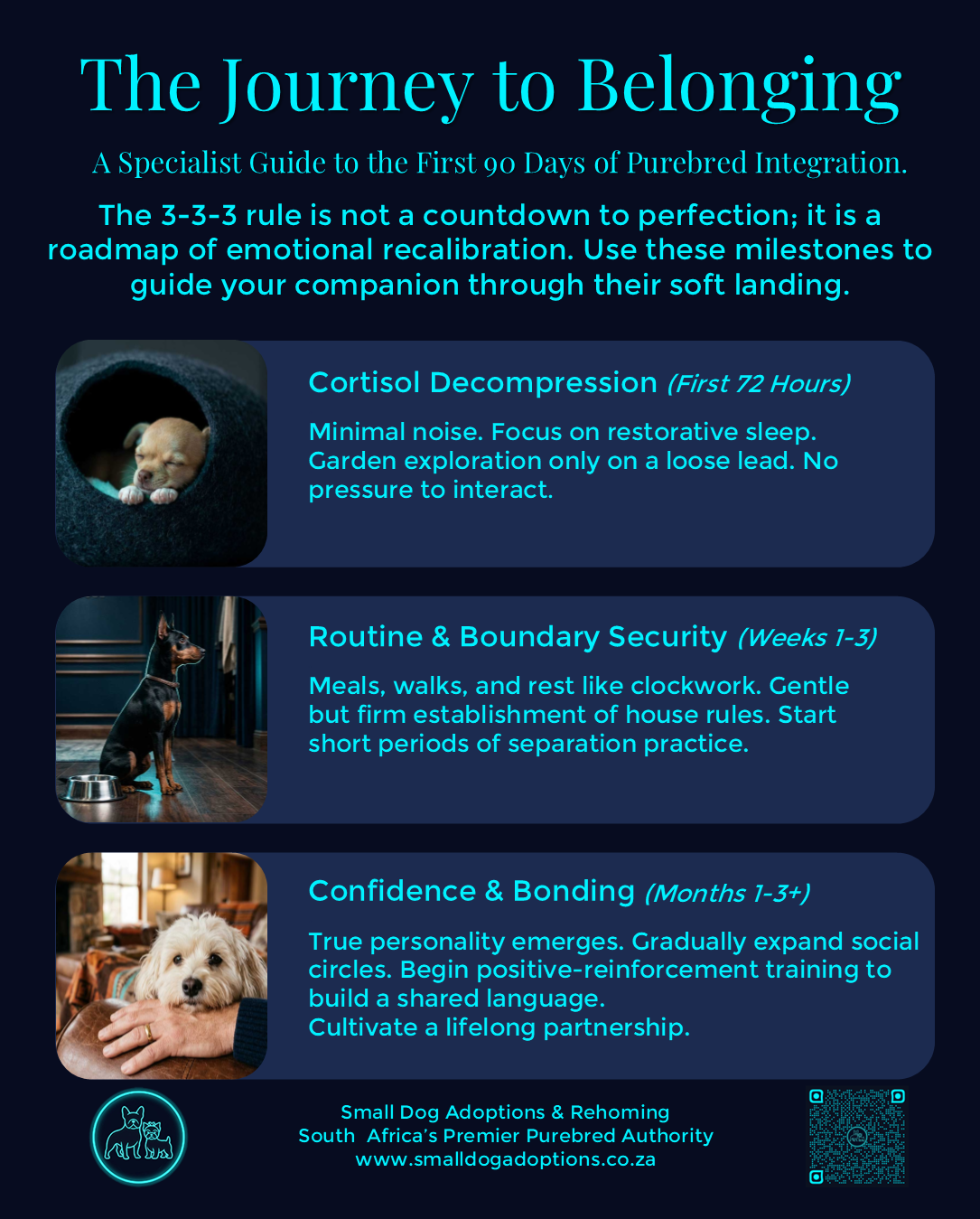
The 3-3-3 rule (3 days, 3 weeks, 3 months) is a valuable roadmap, but it is not a countdown to “perfection.” For highly sensitive small dog breeds like Chihuahuas, Pomeranians, or Yorkies, the nervous system may require more time to exit a state of hyper-vigilance.
Our Philosophy: We focus on physiological milestones. We don’t increase expectations until the dog shows signs of a “soft landing”—relaxed ears, normal eating patterns, and restorative sleep.
Bringing a New Dog Home – Phase 1 – 3

Phase One
Decompression
(The First 72 Hours)
Focus:
Cortisol Decompression & Sensory Safety
The Goal: Transitioning your dog from “Survival Mode” to “Observation Mode.”
The Vibe: Emotional silence. This is the moment your dog begins to exhale.
- The Power of Silence: Keep human chatter to a minimum. High-pitched “baby talk” can actually increase anxiety in a stressed dog.
- The Designated Sanctuary: Provide a high-quality “den” (crate or covered bed) in a low-traffic area. This is their “safe-haven” where they are never touched or disturbed.
- Garden Perimeters: Keep initial outings limited to your garden on a loose lead. This allows them to map the scent profile of their new territory without the “trigger stacking” of a neighborhood walk.
Behaviorist Insight: Small dogs are “pro-active” observers. They need to watch you from a distance to categorize you as “safe.” Avoid direct eye contact or looming over them during this phase.
Behaviorist Insight:
Small dogs are “pro-active” observers. They need to watch you from a distance to categorize you as “safe.” Avoid direct eye contact or looming over them during this phase.
Phase Two
Establishing the Rhythm
(Weeks 1–3)
Focus:
routine stabilization & Boundary Security
The Goal: Moving from “Observation Mode” to “Environmental Competence.”
The Vibe: Predictability. As the dog’s cortisol levels drop, their true personality begins to emerge.
- The “Clockwork” Protocol: Feed, walk, and rest at the exact same times every day. Predictability is the fastest cure for anxiety.
- Separation Training: Start leaving the dog in their sanctuary for 5–15 minutes while you are in another room. This prevents the “velcro dog” syndrome common in small breeds.
- Quality over Quantity: Focus on short, positive interactions rather than long, overwhelming sessions.


Phase Three
The Integrated Bond
(Months 1–3)
Focus:
Confidence Building & shared language
The Goal: Moving from “Resident” to “Partner.”
The Vibe: Confidence. Your new companion no longer expects you to leave or hurt them.
- Social Expansion: Gradually introduce one new visitor at a time. Ensure guests ignore the dog until the dog initiates contact.
- Advanced Training: Now is the time to begin positive-reinforcement training. This builds a “language” between you and your dog, deepening the bond.
- The Shift: You are no longer managing a transition; you are cultivating a partnership.
Specialist Insights for Niche Breeds
Canine Fact: Small dogs (Poms, Chihuahuas, Maltipoos) are highly empathetic. They mirror your energy. If you are anxious about their “progress,” they will remain hyper-vigilant and unsettled. A calm owner creates a calm companion.
Beyond the First 90 Days: Equipping for Excellence
A successful transition doesn’t end at the three-month mark; it evolves into a lifelong partnership. At Small Dog Adoptions, our commitment to our dogs—and their new families—is permanent.
While understanding these phases is essential for a successful match, the most common question we receive from new families is: ‘What do I actually do at 7:00 AM on Day 4?’
Because every hour matters in the early stages of emotional recalibration, we have codified our successful home-to-home transitions into a structured, day-by-day manual.
The First 30 Days: SDA Private Transition Protocol
Maximize your success with our professional-grade digital resources.
While this guide provides the roadmap, our Premium New Owner’s Blueprint provides the step-by-step instructions by taking the guesswork out of your journey with your new companion. Specifically curated for the South African small dog owner, this downloadable masterclass covers:
The Signature Collection | Boutique Pet Partners in South Africa
We are frequently asked which products meet our rigorous standards for safety and quality. To protect the behavioral and physical health of your dog, we have curated the SDA Signature Collection list.
From the specific harnesses that prevent tracheal collapse in Poms and Yorkies to the calming beds that assist in cortisol decompression, we only recommend what is best for your companion.
Secure Your Future: Priority Placement Membership
Because we specialize in high-demand, niche purebreds, our adoption waitlists move quickly. If you are still in the “searching” phase of bringing a new dog home, consider joining our SDA Priority Circle.
The First 30 Days: SDA Private Transition Protocol
Get instant access to your 30 Day Transition Protocol
Your Journey of a Lifetime Starts with a Single, Calm Step
Bringing a new dog home is a marathon of small, beautiful moments. By following a structured behavioral protocol and equipping yourself with the right professional tools, you aren’t just giving a dog a home—you are preserving the legacy of a breed and ensuring a harmonious life for your family.
Small Dog Adoptions & Rehoming is here to support you beyond the transition. If you require further specialist guidance or would like to discuss a specific rehoming case, please reach out to our Specialist.