

The Complete Guide to the English Springer Spaniel in South Africa
The English Springer Spaniel is an exceptionally intelligent, energetic, and affectionate medium-sized dog breed. Renowned for its history as a premier gundog, the Springer is celebrated globally and within South Africa as a versatile, people-pleasing companion.
Whether you are researching the breed to see if it fits your household lifestyle or preparing to welcome an older dog moving from one home to another, understanding their distinct traits, care needs, and health profile is essential.
| Breed Characteristic | Specification |
|---|---|
| Origin | Great Britain (16th Century) |
| Average Weight | Males: 20–25 kg | Females: 18–23 kg |
| Average Height | Males: ~51 cm | Females: ~48 cm at the shoulder |
| Lifespan | 12 to 14 years |
| Coat Variety | Double coat; flat or wavy with distinct feathering |
| Primary Colors | Liver & white, or black & white (often with ticking/freckles) |
| Registration Body | Kennel Union of South Africa (KUSA) – Gundog Group (View Official Breed Standard) |
English Springer Spaniel Lines: Show vs. Field
In South Africa, you will encounter two distinct variations of the English Springer Spaniel. Understanding this difference is essential before welcoming one into your home:

Field/Working Lines:
Bred primarily for tracking and hunting. They feature a lighter, highly athletic build, shorter ears, and a thinner coat with less feathering. They have an exceptionally high prey drive and need intensive daily exercise.
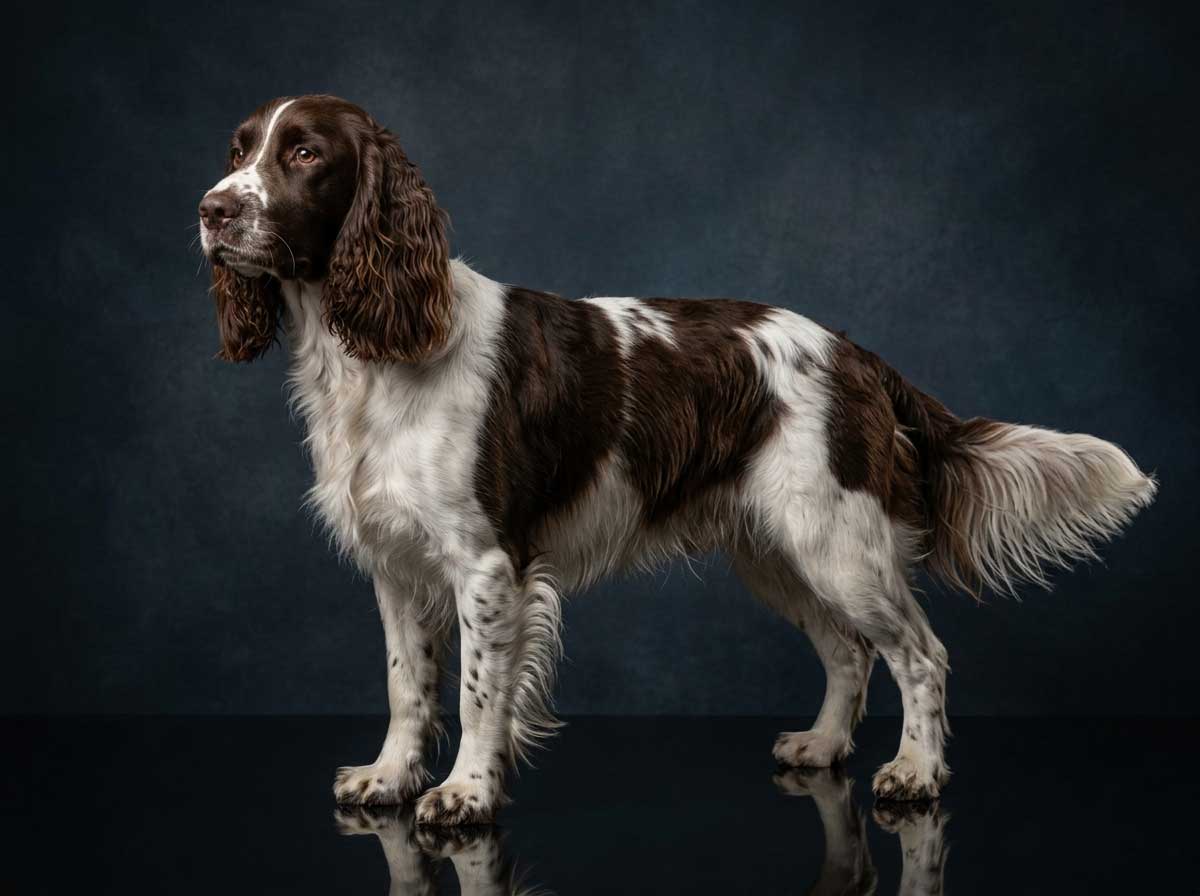
Show (Bench) Lines:
Bred for conformation. They are typically heavier, calmer, and showcase the classic blockier head and long, luxurious, feathered coat. While still very active, they are often easier to manage in a standard suburban household.
English Springer Spaniel Frequently Asked Questions
Before welcoming a new dog into your home, it is natural to have questions about how they adapt to daily life. Below, we answer the most common questions about the English Springer Spaniel breed to help you determine if they are the right match for your household dynamic and environment.
Everyday Care | Exercise | Diet
Physical Activity Requirements
This is a high-energy athlete. A casual walk on a lead around the block is insufficient for an adult Springer Spaniel.
- Daily Exercise:
They require at least 60 to 90 minutes of active exercise per day. - Outlets:
This energy is best directed into off-lead running, fetch sessions, hiking, or swimming. - Mental Stimulation:
Because they are highly intelligent, their minds must be worked alongside their bodies. Puzzle toys, scent tracking games, and advanced obedience training prevent behavioral issues caused by boredom.
Diet & Nutrition Needs
Because Springers are highly active athletes, they require a balanced, nutrient-dense diet rich in high-quality proteins and healthy fats to support their energy levels. However, if they do not receive enough daily exercise, they are prone to gaining weight quickly. Avoid overfeeding or offering too many high-calorie treats, and consider a premium food formulated specifically for active, medium-sized dog breeds to protect their joints and keep them in optimal condition.
Swimming and Pool Safety in South Africa
With their hunting heritage, most Springers have an intense, natural affinity for water. If you have a swimming pool, safety must be your top priority. Ensure your pool is fully secured with a safety fence or a certified pool net, and invest in a special dog pool step.
Even water-loving dogs can panic and drown if they fall in and cannot find a way out. Explicitly train your dog by physically showing them where the steps are located, guiding them out of the water multiple times so they know exactly where to exit if they jump or accidentally fall in.
Grooming & Coat Maintenance
The Springer’s beautiful coat is functional, designed to protect them from thick brush, but it requires diligent maintenance to remain healthy.
- Brushing Frequency:
Their coat requires thorough brushing three to four times a week. The fine, silky “feathering” on their ears, chest, underbelly, and legs is highly prone to mats and tangles. - Trimming:
Regular trimming every 6 to 8 weeks helps keep the coat manageable, particularly around the paws and under the ears. - Ear Cleaning:
Because Springers have long, heavy, droopy ears, air circulation inside the ear canal is restricted. This traps moisture and debris, making them highly susceptible to ear infections (Otitis Externa). Inspect and clean their ears weekly with a vet-approved drying solution, especially after swimming. - Nail and Paw Care:
Keep nails trimmed to avoid joint discomfort. Check their paws regularly for thorns or “khakibos” seeds after outdoor walks.
Training and Socialization
Trainability
Springers are remarkably intelligent and eager to please, making them highly trainable. They respond exceptionally well to positive reinforcement techniques (rewards, praise, and treats). Harsh corrections can backfire, causing a sensitive Springer to shut down.
Socialization Needs
While naturally friendly, a lack of early socialization can cause a Springer to become timid or hyper-excitable around strange dogs and people. Exposing them gently to different environments, noises, and vehicles helps them mature into a steady, well-adjusted adult.

Rehoming or Adopting a Springer Spaniel
Because of their exceptionally high energy levels and need for mental stimulation, English Springer Spaniels are occasionally surrendered when owners underestimate their care demands.
Many families who find they have underestimated the breed ask Small Dog Adoptions & Rehoming (SDA) to assist with “home-to-home” rehoming. A confined, traditional shelter environment can be incredibly overwhelming and stressful for this highly active, sensitive gundog breed. By coordinating direct home-to-home transitions, we ensure they move safely and calmly from one loving family straight to another.
Common Breed-Specific Health Considerations
01
Hip and Elbow Dysplasia:
A hereditary malformation of the joints that can cause painful arthritis and mobility issues. Regular, low-impact exercise and weight control help manage this risk.
02
Progressive Retinal Atrophy (PRA):
A genetic eye disorder that causes gradual degeneration of the retina, eventually leading to blindness.
03
Ear Infections:
Due to the conformation of their drop ears, moisture retention frequently causes yeast or bacterial overgrowth.
04
Phosphofructokinase (PFK) Deficiency:
A rare metabolic enzyme disorder that affects red blood cells and muscle tissue.
05
Skin Allergies:
They can be prone to atopic dermatitis, showing up as itchy skin, often aggravated by environmental allergens or incorrect diets.

Final Thoughts: Is the English Springer Spaniel Right for Your Home?
Welcoming an English Springer Spaniel into your life is a deeply rewarding commitment. If you can match their high energy levels, provide them with plenty of mental stimulation, and commit to regular grooming, you will be rewarded with one of the most affectionate, loyal, and joyful companions in the canine world.
Whether you are ready to adopt or are looking for guidance on transitioning an older Springer into a new home, we are here to support you every step of the way.
Are you hoping to open your heart to a Springer Spaniel?
- 🐾 View Our Available Dogs for Adoption
- 📧 Get in Touch with Small Dog Adoptions & Rehoming, if you have any questions or need advice about our home-to-home rehoming process.